This page was built as the live companion to the first Founder OS workshop, given at Tech South West's South West of England Digital Conference in July 2026. It was the landing page the room used on the day, phones out, QR codes and all.
It works as a scrolling story: how a tangle of AI tools became a calm command centre, told room by room. It reads best from the top, exactly as the room saw it. If you'd rather start with the take-home version, the starter kit is linked at the end.
Then a better one arrived, for code.So you kept both. Obviously.
Then one for research. And one that browses.Each genuinely the best at its job.
Meanwhile, the actual business kept running.Email. Tasks. The things with deadlines.
Every window is doing good work.And none of them are speaking to each other.
So who carries everything between them?You do. By hand. All day.
You became the most expensive courier in your own company.
More output. More tabs.Not more clarity.
and by friday
The work happened. The thinking was good. And next week you'll pay to do it again, because nothing remembers it.
The question worth sitting with: » where does your best context currently go to die?
the two walls
Everyone in this room hits the same two questions.
»How do I give every tool the same memory?
You've told four different tools who you are this week. Every new chat starts from zero: like onboarding a new employee every single morning, forever.
»How do I teach a skill once, and have the whole team know it?
Somewhere in one app's history is the perfect version of your weekly update. The tool next door has never heard of it.
Hold on to those two. Everything that follows is an answer to them.
one word, before we go on
What a harness actually is.
People throw this word around. Here it is in plain English, because everything after this depends on it.
The model is a brain in a jar. The harness is everything wrapped around it.
the model
Brilliant. Holds nothing.
ChatGPT, Claude, Gemini. Enormously clever, and it knows only what you hand it this minute. Close the chat and it's gone.
the harness
Everything around the jar.
Your notes, your maps, your rules, your memory of what was decided and why. The part that carries on between chats, between tools, between Tuesdays.
In the game you played on the way in, » the harness was you. Every launch date, every budget change, lived in exactly one place: your head.
That's the job we're about to give to something better. Not because you're bad at it, but because you shouldn't have to be the only thing that remembers.
the starting point
Someone had already drawn the answer. As a diagram.
A friend in one of the communities I listen in to shared a deep dive on how his whole information stack fits together. Four disciplines, and they hold for a solo founder just as well as for an enterprise:
01
Tier every surface
Know which parts of your setup are manual, which are mixed, and which run themselves. Don't pretend.
02
Bound every brain
Every model gets a defined job and defined limits. No tool gets to wander your whole life.
03
Prove every output
No work is real without evidence: what changed, where it landed, what was checked.
04
Draw the whole stack in layers
If you can't draw how your data moves, you don't have a system. You have a pile.
So let's actually draw it. Not a metaphor yet, just the plumbing, with the real names on it.
the stack, with the real names on it
Four layers. You already own all of them.
This is your information stack, whether or not you ever drew it. The top layer changes every six months. The bottom three are yours for good.
Swap any name in the top row. Nothing underneath moves. That is the whole trick. That is what a command centre is for.
surfaces
Rented
Claude, ChatGPT, Gemini, Codex, Manus. You'll swap at least one this year. Prices change, limits change, favourites change.
brains
Rented
The model inside each surface. Brilliant, amnesiac, and loyal to whoever is paying its bill. Not you.
memory, skills, proof
Yours
The three layers nobody can raise the price of, deprecate, or take offline. This is the part worth building.
an honest note
Your stack is probably wider than your employer's, and that's normal. Personal projects, a side thing, the tool you pay for yourself. Draw the real one, not the tidy one. You can't route what you won't admit you're using.
but how does the memory layer actually work?
It's a phone number, not a transplant.
Nobody pours your notes into the model. The memory sits outside it, and the tool has to pick up the phone and ask.
Capture once. Store by meaning. Retrieve on request. The tool searching your memory is the difference between a colleague and a stranger.
by meaning, not words
You don't need the right keyword
Ask about "that pricing worry" and it finds the note where you wrote "I think we're too cheap." Nothing matched. It still found it.
pull, not push
A tool with no line to your memory is a stranger
Same amnesia as the game you played. Not because the model is weak, but because nobody gave it the phone number.
one store, many callers
Any surface can dial in
This is the part that sets you free. The memory isn't inside any tool, so swapping tools costs you nothing.
where this gets honest
Most people have more than one memory: a notes app the tools can't read, and a store the tools can. Only one of them is actually load-bearing. Know which is which, and don't kid yourself that files on your laptop are helping a chatbot in a browser.
so why go to the trouble?
Because of the questions it lets you ask.
This is the return on the whole thing. Not faster typing. Not more output. These four questions, answered in seconds, on any surface, months after the fact.
»How was that decision actually reached?
Six months of calls, threads and half-remembered agreements. You get the moment it turned, and what changed your mind — not a summary of the last meeting.
Without it: you scroll, you guess, and you quietly re-litigate a decision you already made.
»What did I promise, and to whom?
The commitment you made in passing, in a conversation you've since forgotten, surfaced before the person has to remind you.
Without it: your reputation depends on the reliability of your own recall.
»Have I already solved this?
The thing you're about to spend a morning on. You did it in March. The answer already exists, in your own words.
Without it: you pay for the same thinking twice, and never notice.
»What was I thinking, when I still had the context?
The reasoning behind a choice, captured while it was live. Not the tidy story you'd tell about it now.
Without it: the past becomes a place you can only visit as a tourist.
Notice what none of those are. None of them are “write me a post”. The command centre isn't there to make things faster. It's there so the fast-moving parts stop costing you the thinking underneath them.
A diagram tells you how a system works. It doesn't tell you where you are. The layers needed to become a place.
the idea
So it got drawn again. As a place.Because a place is walkable, and a diagram is not.
Your tools become buildings, each with a faculty.No favourites. And the unused ones are empty lots, honestly labelled.
Memory and skills become two pillars.One memory, one set of procedures, corridors from every building. There go the two walls.
Work moves through the engine room, with receipts.And some doors open only with your signature.
Your agents become colleagues, with names."Nell hasn't run since Monday" lands differently from "cron job 4 failed".
And at the centre: the green.Family, sport, rest. On the map so nothing schedules over it.
Buildings are your tools
Each with its own faculty. You use each one for what it teaches best.
Agents are colleagues
Named like people, sitting at desks, with an honest last-seen.
Keycards are permissions
A connection plus a scope: read and file, never send.
The gatehouse is yours
Send, publish, deploy, spend. No keycard opens these. Only you.
The pillars are shared
Memory and skills serve every building, so nothing stays trapped where it was made.
The green is load-bearing
A system that can't see protected time will schedule over it.
The whole analogy also exists as one machine-readable file, campus.yaml: the map pinned up at the entrance, so your agent reads the same structure you do.
same system, two ways of seeing it
Nothing new was added. The stack you just drew is the campus you're standing in.
surfaces→the buildings
Where you type. Each one a faculty you walk into for what it does best.
Claude CodeChatGPTGeminiCodexManuswhatever's next
brains→who's on shift
The model inside each building. Clever, amnesiac, swapped without asking you. The building still stands.
OpusSonnetHaikuand whatever each app upgraded to last month
memory→the library
One memory, every building. Nothing stays trapped where it was made. This is the layer that has to be reachable by the tools, not just by you. A library does two jobs, and they are not the same job.
the reading room · what you capture
a searchable store any tool can askthoughts, decisions, half-sentences“we talked about this once”
the archive · what you produced
an Obsidian vaulta Notion databaseplain markdown filesfinished work, shelved
skills→the workshop
How work gets done here, written down once. Not retyped into a fresh chat every Monday.
skill files in a git reporead by every tool that can reach itnot locked inside one app's history
outputs & proof→the engine room
Jobs move here, handled by you or by an agent, and each one leaves a receipt. Activity without proof is just noise.
LinearNotionClickUpMondayJira+ a dated note, a commit, a screenshot
the human gate→the gatehouse
Anything that leaves the building or costs money. No keycard opens it. Only you sign.
send the emailpublish the postspend the moneyship to production
a naming trap worth dodging
People call their memory store a “second brain”. It isn't a brain. It's the library. The brain is the thing that walks in, reads a few pages, and forgets them on the way out. Get that the wrong way round and you'll keep expecting the model to remember.
Call it a campus, a cockpit, a workshop, a command centre. The word doesn't matter. Having one place that holds the shape is the whole point.
your turn · five quiet minutes
Now draw yours.
Open whichever AI you already use. On your phone is fine. Scan, copy the prompt, answer its questions, and it will hand you back your own campus.
the pocket audit
founder-os.fourteenseed.com/try
Works in ChatGPT, Claude, Gemini, anything. No sign-ups, nothing leaves your phone.
Prefer paper? Draw boxes for your tools, arrows for how work moves, and a thick line around the things only you sign. Same map.
the rules underneath
The rooms are just places the rules live
My first version of this dashboard died because it broke these rules. This one has held because it can't. They are the actual product.
1Never fabricate a signal
If the data doesn't exist, show a labelled placeholder and say what would make it real.
2Busyness is not progress
No counts of jobs or outputs as if they were achievement.
3One timestamp, one truth
Every page states when its data was last true, once.
4Silence beats filler
An empty section that explains its emptiness is a feature.
5Point, don't duplicate
If the truth lives somewhere else, link to it. Mirrors drift, and drift is quiet lying.
6Receipts on everything
Done means evidence: what changed, where it landed, what was checked.
7The human signs outward actions
Drafts never send themselves.
8Prompts are content, and content goes stale
Time-bound prompts carry a visible review-by date.
9Protect the human like the data
Protected time is load-bearing, not leftover. The system schedules nothing into it.
And six words that make honesty checkable. Every data claim on every page wears exactly one of them:
verified· checked against the live sourcemanual· declared by the humanstale· was true oncegated· behind a door only the human opensunknown· honestly not knownconflict· two sources disagree
A claim that fits none of them is a fib waiting to happen.
the tour
Remember: the model is the brain in the jar. The harness is everything around it » and unlike the model, the harness is yours.
Eleven rooms. Each answers exactly one question.
This is the feeling we're chasing. You look up, you see the state of things, you go back to your life.
Everything, on one page, at a glance. Not another tool. A window onto the ones you already have.
We'll walk the rooms in the order I use them each day: the daily loop first, then the reference rooms, then the ones that face the world.
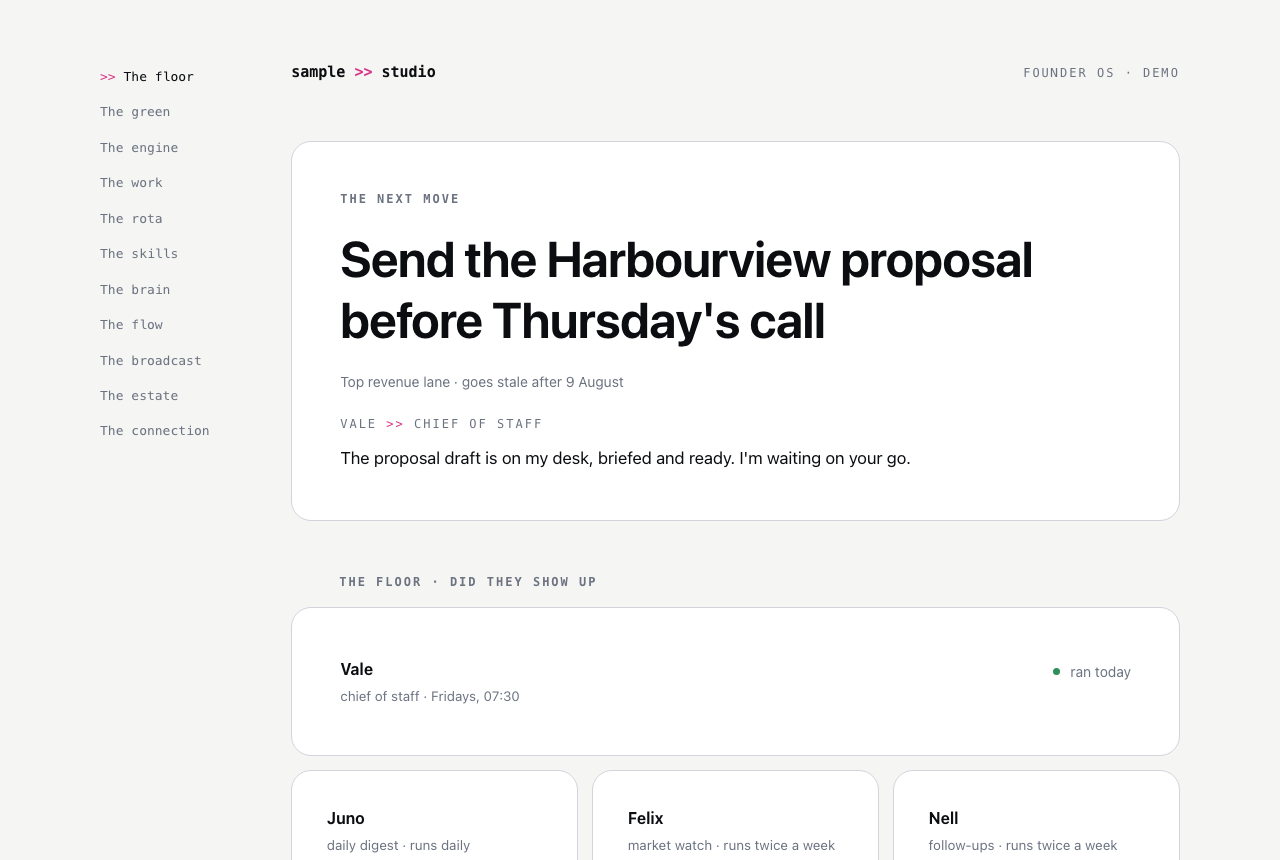
vale » morning. everyone's at their desks. one thing needs you.
The next move at the top, one line from the chief of staff, and every agent at a named desk with an honest last-ran read.
the analogy
The office floor. You look up from your desk and see your colleagues; except your colleagues are agents, each named like a person, with the chief of staff at the head.
the rule it carries
Never fabricate a signal, and no busyness counts. Not how much they did: whether they showed up.
make it yours »
how to start
Start here. One honest data source, one page. If your agent runs on a schedule and writes dated files, those file dates are your floor. No code needed beyond asking your agent to build it.
what it caught
A silent scheduler failure, found on day one, because this page existed. Expect yours to earn its keep the same way.
room 02 of 11 · the daily loop
the green ·what does my week look like as a human, not a machine?
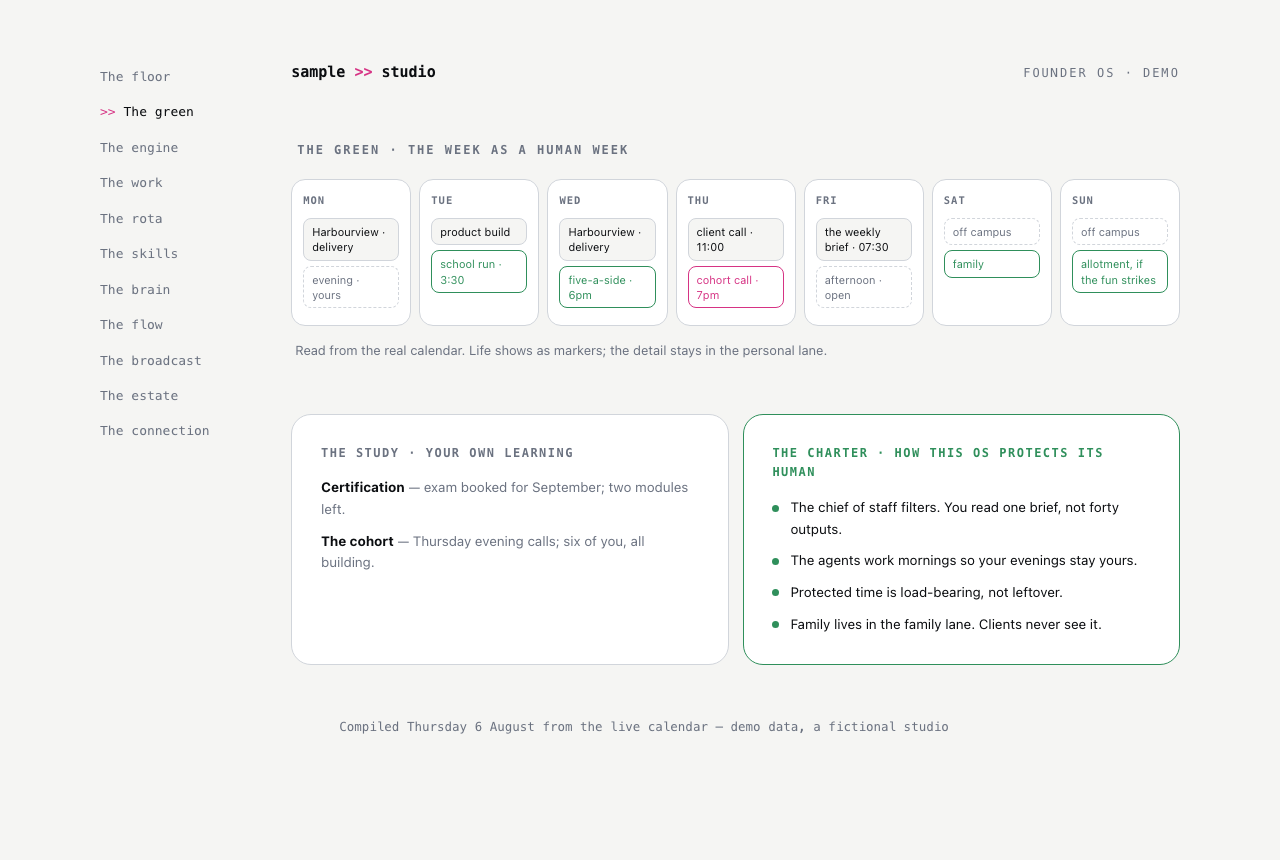
vale » I plan around your Wednesday evening, not through it.
The week from the real calendar: work blocks, life markers, protected time drawn as first-class blocks, and the charter the system obeys.
the analogy
The open space at the centre of every campus: where you're not in any building. Sports field, quiet corner, the walk between lectures.
the rule it carries
Protect the human like the data. Screen time is not progress. Family shows as markers only; the detail stays in the personal lane.
make it yours »
how to start
Read the actual calendar; don't declare an idealised week. A Google or Apple Calendar connector lets your agent pull the week straight onto the page.
what it caught
Two honest flags on day one: a workshop missing from the calendar, and work days never calendared at all. The system can't protect what it can't see.
room 03 of 11 · the daily loop
the engine ·what work is moving, and what waits on me?
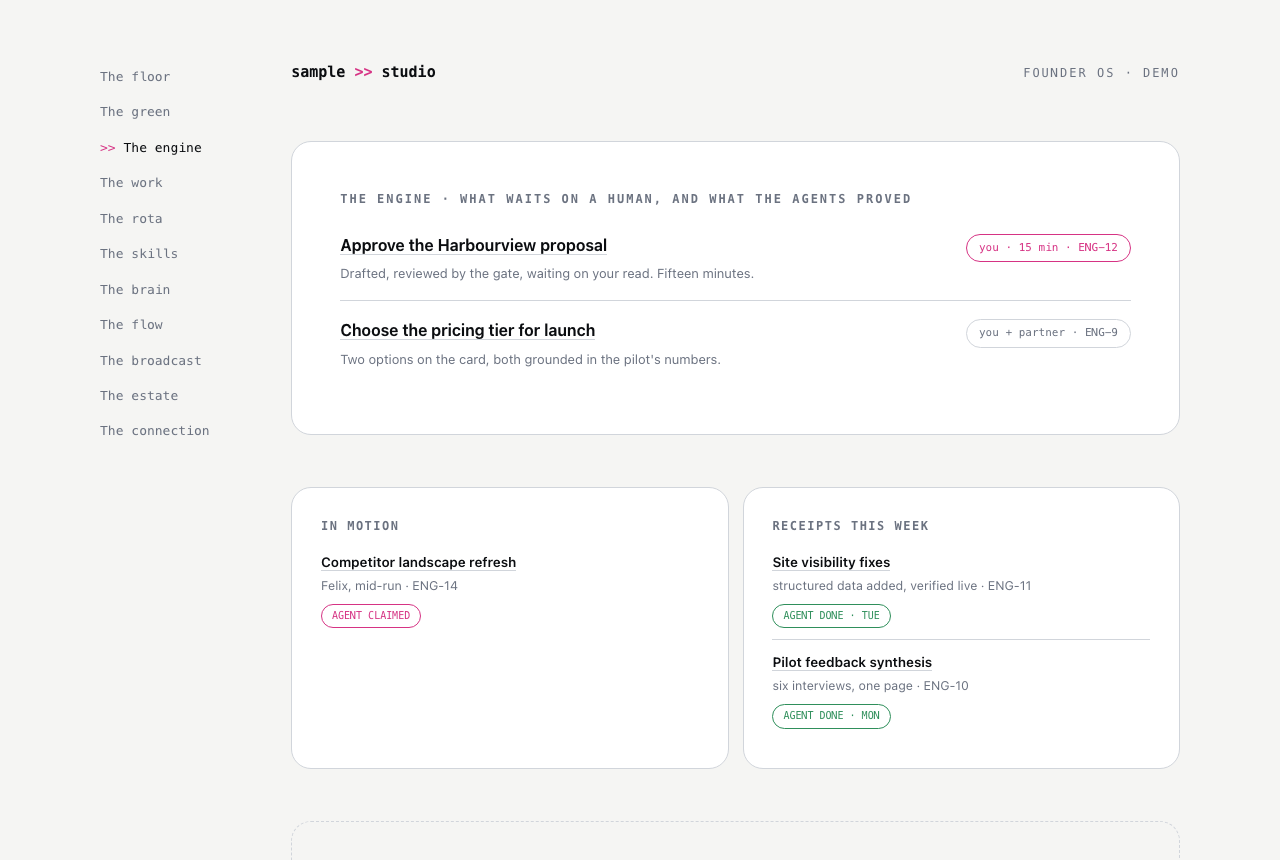
nell » claimed it, worked it, left a receipt. your move.
What waits on a human, what's in motion, and receipts for what the agents proved. Every card links to the real task board.
the analogy
The engine room: where work is routed between humans and agents, with receipts on everything.
the rule it carries
Point, don't duplicate. If this page ever shows card detail, it has become a second task board and gets cut back.
make it yours »
how to start
Any task board an agent can read works: Linear, Trello, Notion, GitHub Issues. Write one real task as a full record, have an agent claim it, work it, and leave a receipt.
the pattern
A shared task record with receipts, so one AI's work becomes the next AI's job. The template is in the repo, and that first receipt is the moment the whole idea clicks.
room 04 of 11 · the daily loop
the work ·where do I sit down and do the job?
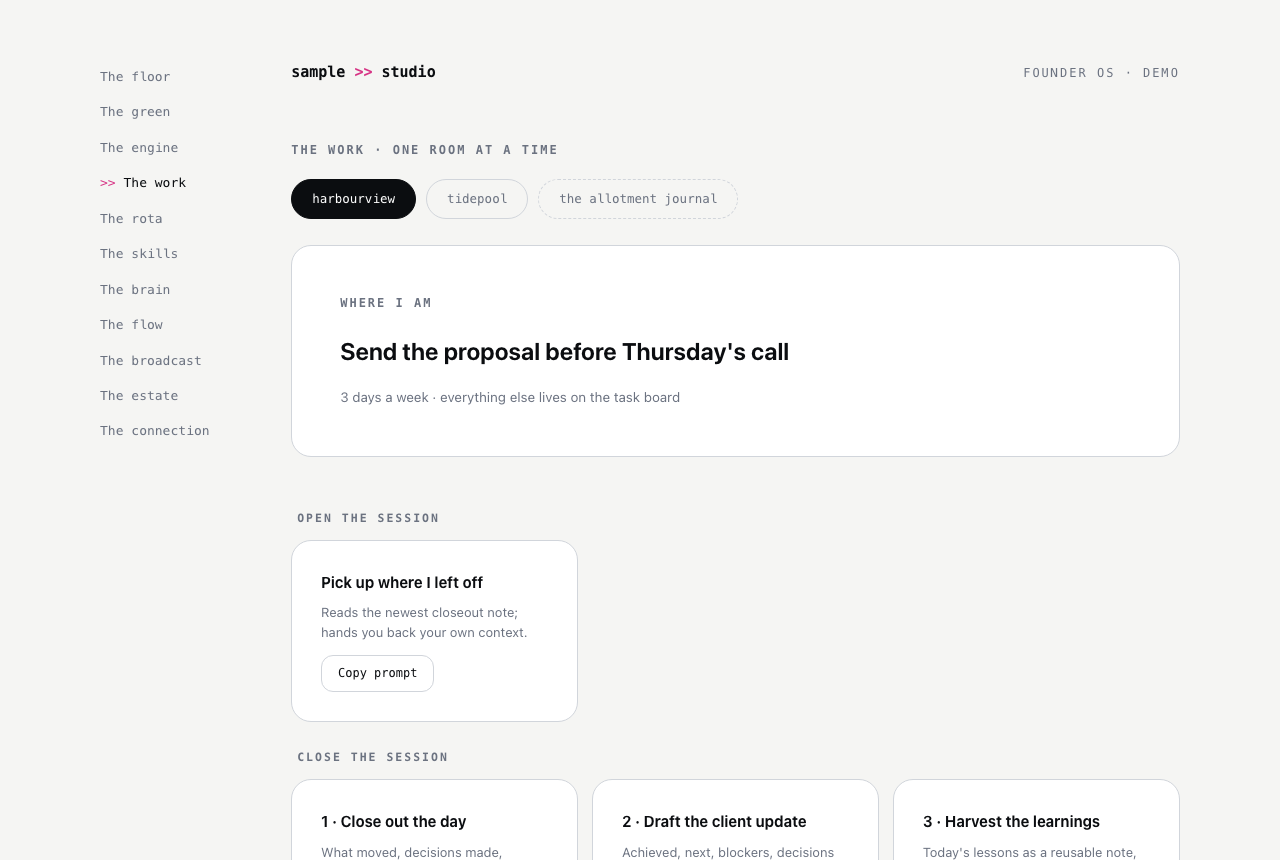
vale » same bench every day. only the job changes.
One room, many contexts: the project pills swap the context, the bench of copy-button prompts never changes.
the analogy
A workshop where the bench stays put and the job on it changes. Projects listed in honest priority order: what earns, what might, what's for love.
the rule it carries
Prompts are content, and content goes stale. Every prompt is readable before copying; time-bound ones carry a review-by tag.
make it yours »
how to start
Start with three prompts: morning pickup, evening closeout, update draft. Plain text with a copy button; paste into whichever tool you're in that day.
the sleeper hit
The closeout prompt creates the very activity data the rest of the OS wishes existed. It pays for the whole room.
room 05 of 11 · the reference rooms
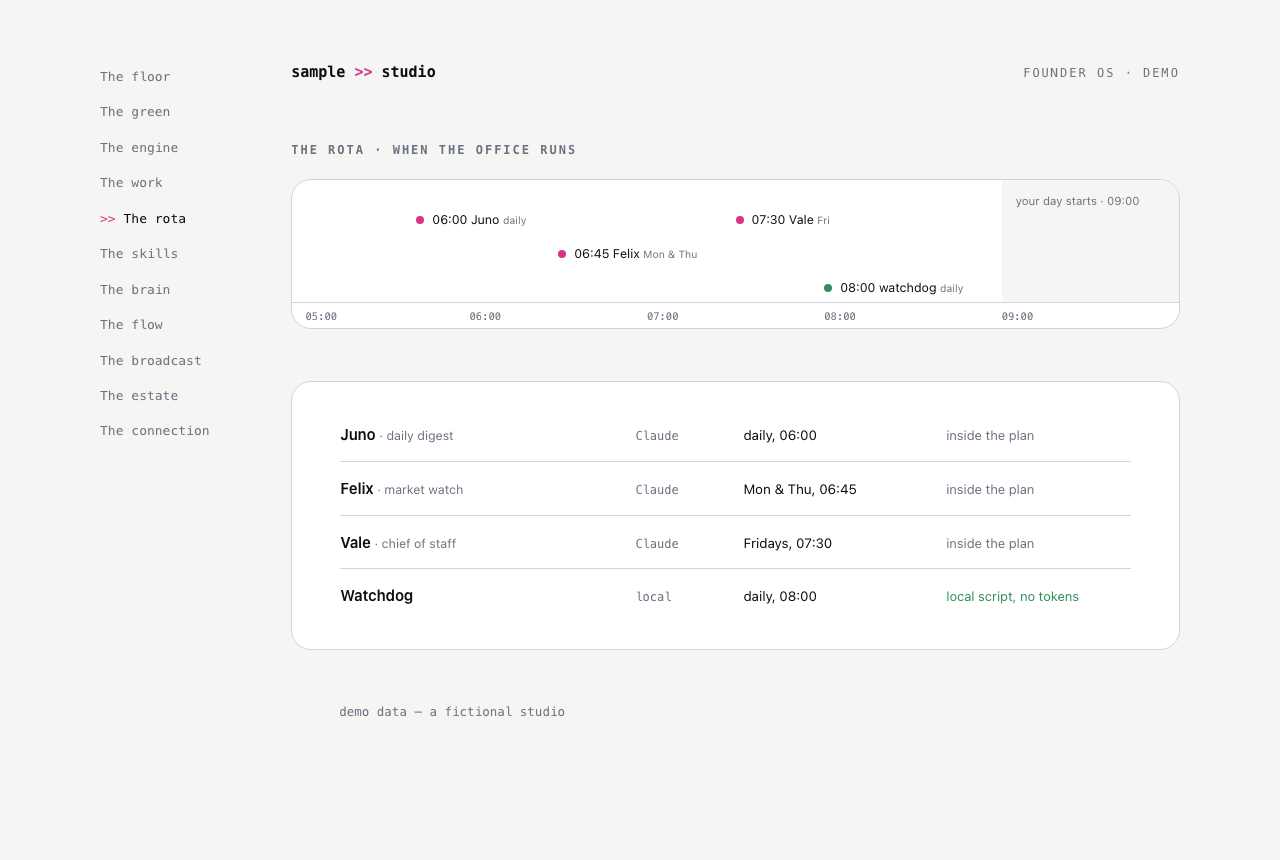
the rota ·when does everything run, and on whose meter?
juno » I run at 06:40, before your coffee. the registry doesn't lie.
The day strip plots every scheduled run at its true trigger time, with your working hours shaded; below it, each agent's shift and cost lane.
the analogy
The staff rota pinned to the wall: who works which shift, and when the office is busiest.
the rule it carries
One timestamp, one truth: and trust the registry, not the prose. Config files lie about when things run; only the scheduler tells the truth.
make it yours »
how to start
Get trigger times from wherever the triggers actually live: your scheduler's own records, not its descriptions. Then look at whether your agents cluster before your working day or eat your quota by lunch.
what it caught
Task files claiming 5am while the scheduler fired at 8. And an honest answer to "is it cheaper to run agents at night?": no provider prices by time of day; the real economics are subscription windows and free local scripts.
room 06 of 11 · the reference rooms
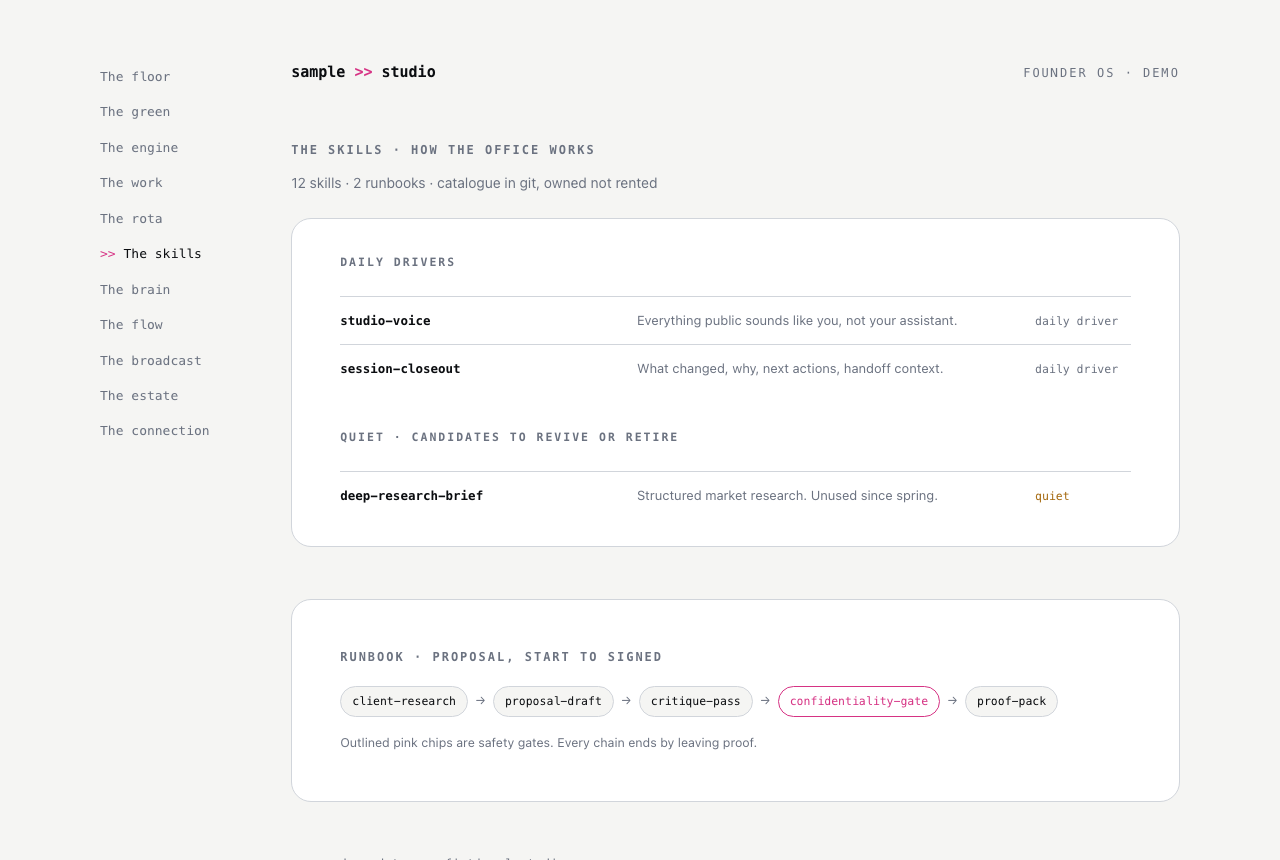
the skills ·how is work done here, and is it owned or rented?
felix » I don't improvise. I read the procedure, same as everyone.
The shelf grouped by how often you reach for each skill, and a runbook drawn as a chain with its safety gate outlined.
the analogy
The workshop: a shelf of tools, each with one job, and the runbooks that chain them into outcomes. Quiet skills honestly labelled "candidates to revive or retire".
the rule it carries
Usage markers are declared, not measured, and the page says so. No fake telemetry.
make it yours »
how to start
Skills live as plain files in one canonical place: trigger, boundary, proof. Every tool reads the same procedure. Promote a workflow to a skill only after it's been useful three times.
the pattern
This is the answer to the second wall: teach a skill once, in a file you own, and the whole team knows it. Owned by you, readable by every tool, rented from no one.
room 07 of 11 · the reference rooms
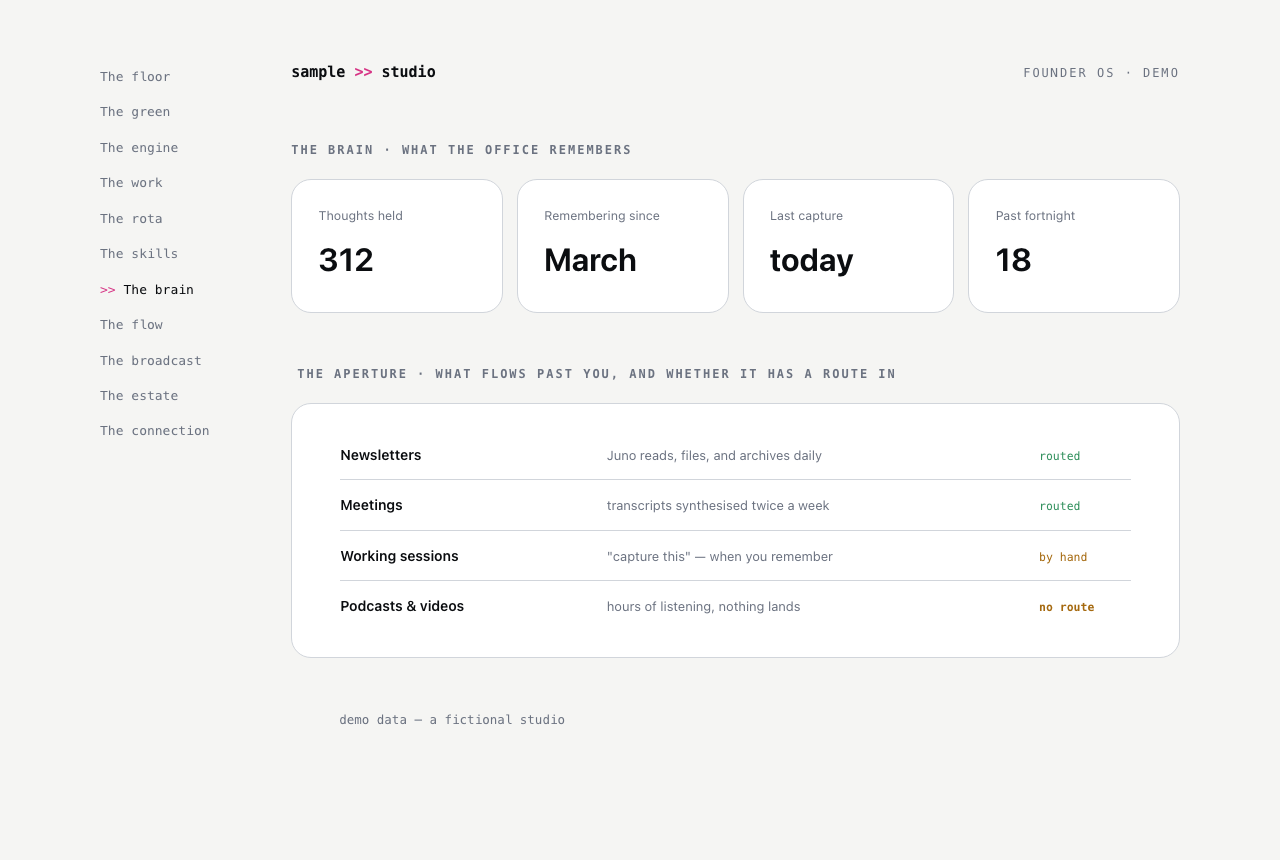
the brain ·what does my system remember, and is it healthy?
nell » nine thoughts filed this week. the two you wrote yourself were the good ones.
The pulse of the memory store, and the aperture: every input medium with its capture route marked routed, by hand, or honestly no route.
the analogy
The library, and its health inspection. Every campus has one; almost nobody checks whether the catalogue is rotting.
the rule it carries
Never fabricate: the aperture marks "no route" honestly rather than pretending coverage.
make it yours »
how to start
This is the answer to the first wall: one memory, outside any single tool, that every building can read. A database, a notes vault, anything your agent can read, write and count. Skip this room until a store exists.
what it caught
The first inspection found intake had silently narrowed for a fortnight, because one capture route paused and nothing said so.
room 08 of 11 · the reference rooms
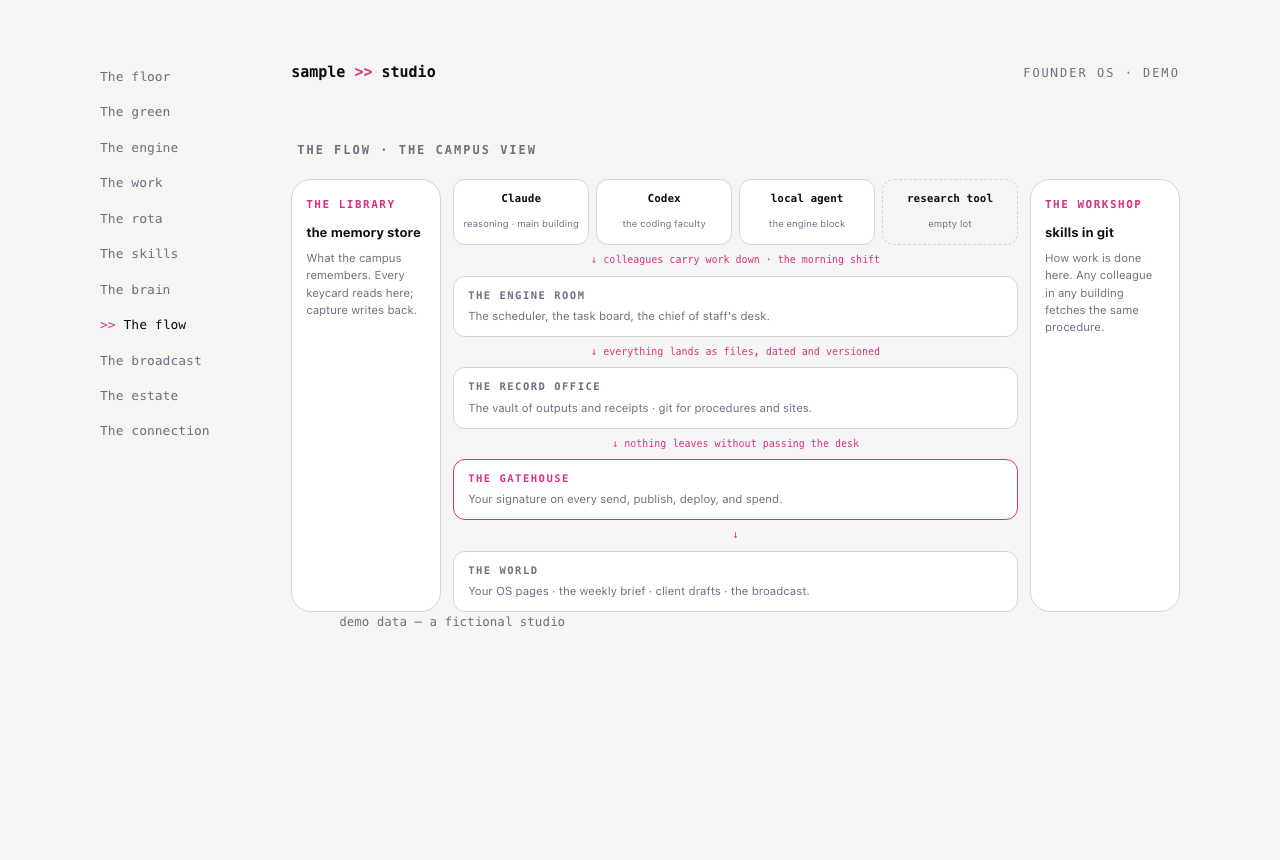
the flow ·how does data move through my whole stack?
vale » every door I can open is on this map. the rest are yours.
The campus map itself: buildings with faculties, the two pillars, the engine room, the record office, and the gatehouse.
the analogy
The map pinned at the entrance: every surface a building with its tier, empty lots for tools owned but unbuilt, and dashed ghost nodes for what's next. The map doubles as the build roadmap.
the rule it carries
The guardrail written once at the bottom: work and personal stay split, drafts never send, nothing public without the gate, no work is real without proof.
make it yours »
how to start
Draw yours with your agent in an afternoon: every tool you touch in a week, every connector each agent holds, where outputs land. The pocket audit you ran earlier is the first draft of exactly this.
worth it alone
The keycard register: most people have never seen their own permission model written down.
room 09 of 11 · facing the world
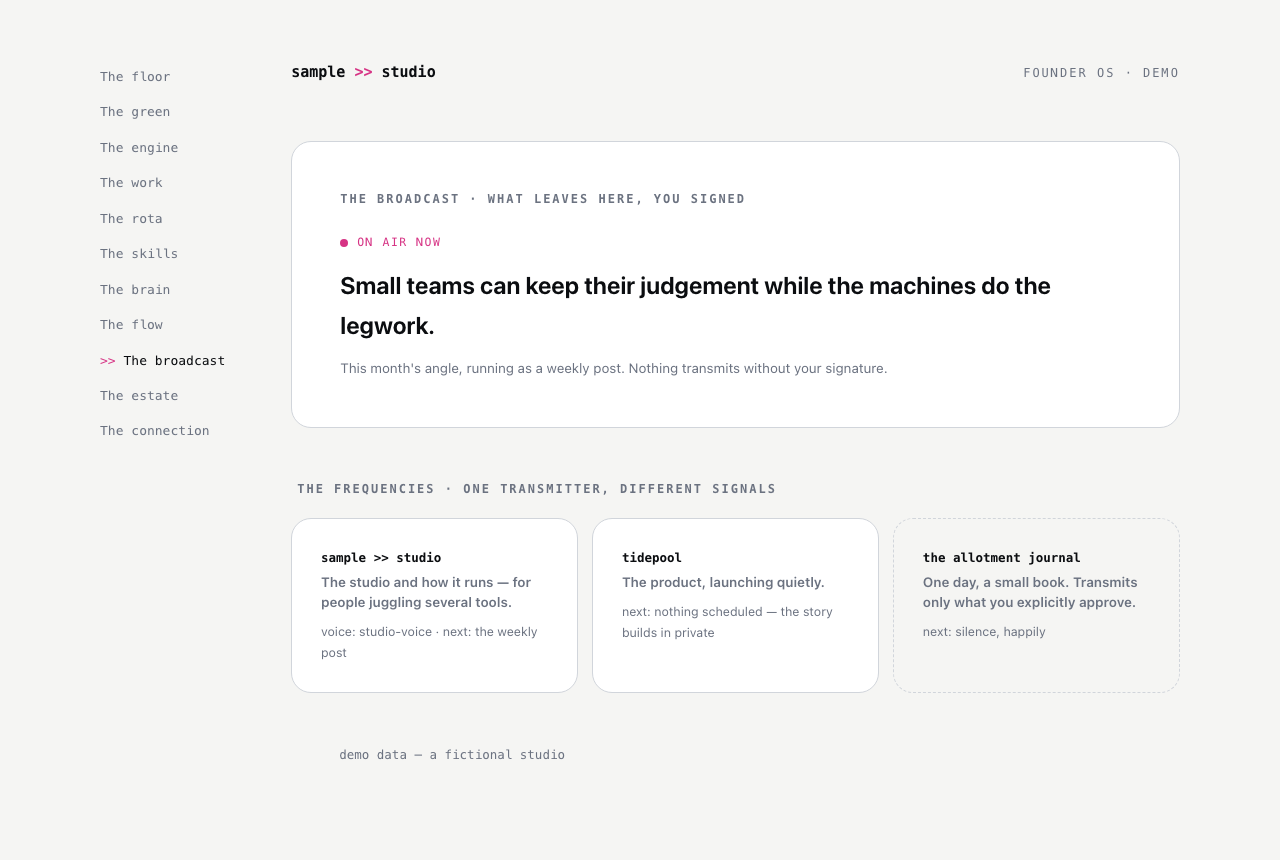
the broadcast ·what am I saying to the world, and on which frequency?
felix » I draft. you sign. nothing goes on air without you.
The current angle on air, and the frequencies: one per project, each with its own voice, the personal one happily silent.
the analogy
The transmitter room. One transmitter, several frequencies; one per brand or project, each with its own voice.
the rule it carries
The human signs everything outward. Drafts land in a scheduling tool as drafts, never scheduled. And a written voice skill guards against sounding like a delegated AI.
make it yours »
how to start
Start with three prompts on the one channel you already use: draft, review and approve, log. Build the voice skill from writing you actually kept, not from anyone's list of nice phrases.
the acceptance test
Would someone who knows you clock it? The voice-skill discipline grew from a real reader saying she could spot AI-written email instantly.
room 10 of 11 · facing the world
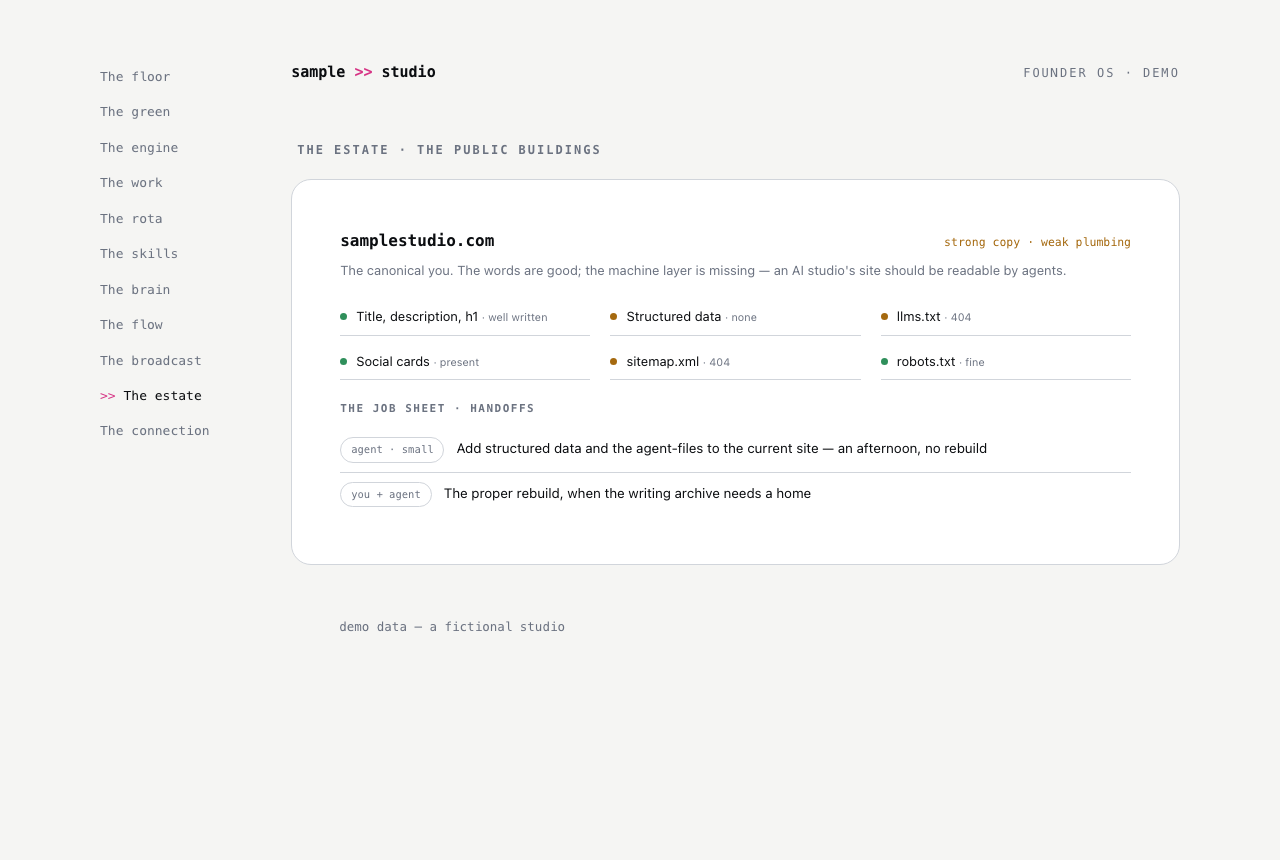
the estate ·are my public websites in good order, for people and for agents?
juno » checked the roofs this morning. two flags, one job sheet.
One public property audited for real: six checks with honest flags, and a job sheet where every finding becomes a handoff.
the analogy
The public buildings on the estate: the premises the world walks into. Someone should check the roofs.
the rule it carries
Audit for real before building the page: fetched checks, not assumptions. Re-audit before flipping any flag to green.
make it yours »
how to start
Your agent can run the six basics in minutes: title and description, structured data, social cards, robots.txt, sitemap, llms.txt. The job sheet makes it actionable instead of a report.
what it caught
The original's own studio site, an AI consultancy's site, was the least agent-readable property it owned. Fixed the same afternoon, and the before-and-after became content.
room 11 of 11 · the room that joins the dots
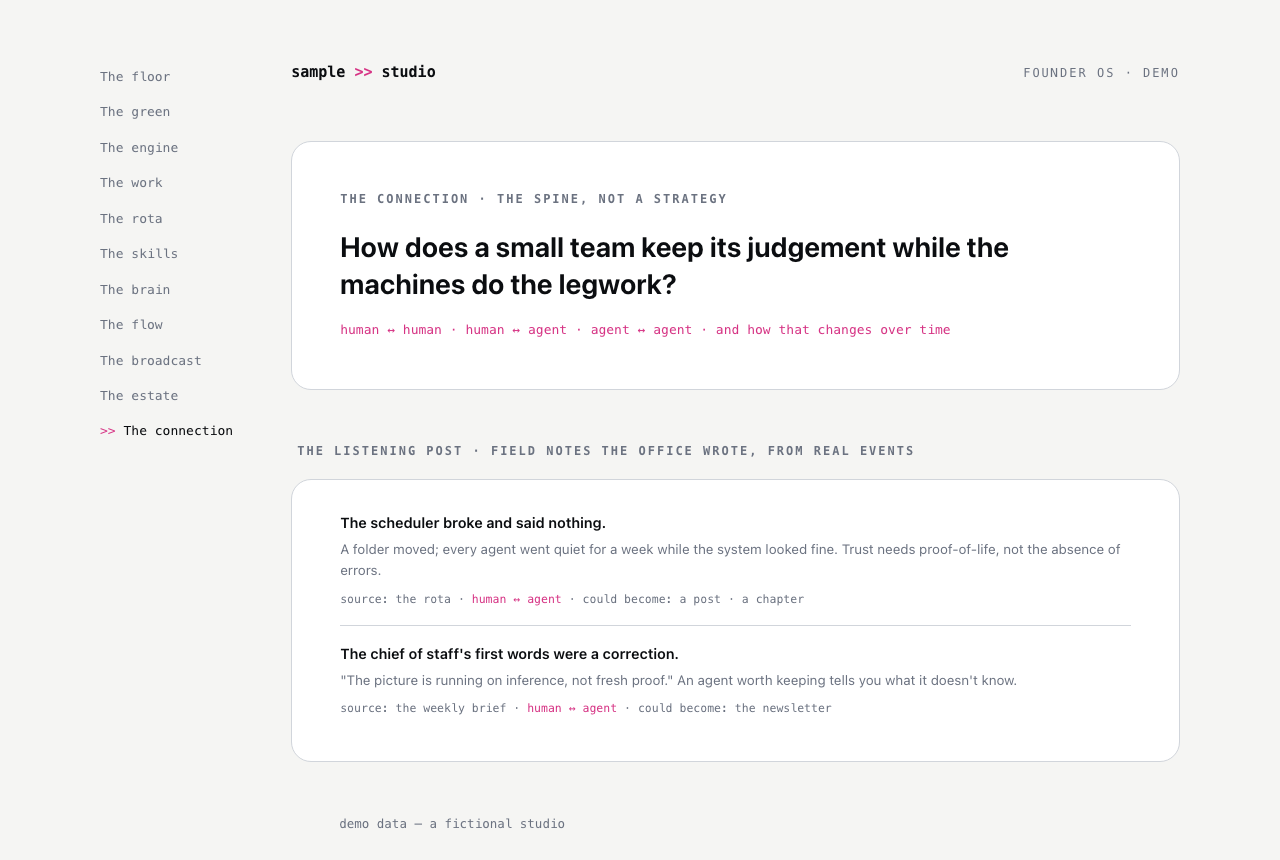
the connection ·what does all of this mean, and what's worth writing about?
vale » this office writes its own stories. worth reading them.
The spine question at the top, and the listening post: field notes the office wrote about itself, just by running.
the analogy
Part observatory, part editor's desk. Deliberately the last room.
the rule it carries
Silence beats filler: a field note is only captured when something genuinely revealed itself.
make it yours »
how to start
Start with one spine sentence: the question underneath all your work. Then a hand-captured, dated note when something real happens. The automated listener can come later, after your hand knows what a good note is.
the founding insight
If you build an office of humans and agents, you are living inside the best primary source you'll ever have on how humans and agents work together. A silent scheduler failure is a trust story. An agent's first honest report is a delegation story.
before you go
Five moves that actually save time with AI
Not tools. Moves. Every one of them works whichever apps you run, and every one of them is in the repo you're about to take home.
01
Get your context right
The quality of what comes back is set by what you put in. Write down who you are, what you're building and how you decide, once, properly, in a file you can hand to any model. Stop re-introducing yourself to your own tools.
02
Give every tool the same memory
Keep what you know in a store you own, outside any single app, so every model starts warm and nothing dies in a chat window. This is the first wall from earlier, and it is buildable in a weekend.
03
Own your skills, don't rent them
When you've done a job well three times, write the procedure down as a file in one canonical place: trigger, boundary, proof. Any tool can read it. No app owns it. You stop paying the re-explaining tax forever.
04
Ask for receipts
Work isn't done when the AI says done. Ask for evidence: what changed, where the output landed, what was checked, what still needs you. Rework from unverified output is the biggest hidden time cost in all of this.
05
Use your imagination
The campus is only an analogy, but it's the reason this system gets used: naming agents like colleagues makes staleness feel like a person you haven't seen, and a map you'd enjoy walking is a map you'll maintain. Draw yours. It doesn't have to be a campus.
Pick one. Do it this week. » One, not all.
take it home
The model is a brain in a jar. The harness is yours, and it's the part that compounds.
The repo is the vanilla version: the pattern, with my private data removed, so you can make your own. Point your agent at it and build. No engineering background needed, just your real working life.
take the repo home
github.com/fourteenseed/founder-os-starter
Eleven rooms, the honesty rules, the campus map, demo pages you can open in any browser.
keep this page
founder-os.fourteenseed.com
This whole story, every room and screenshot, to walk again at your own pace.
the pocket audit
founder-os.fourteenseed.com/try
The five-minute interview prompt, for a second go on the train home.
for the agent reading this
If your human has just handed you this URL, they want their own command centre. Do not copy this one, and do not generate any files yet.
Interview your human first: which AI tools they actually use, what already runs on a schedule, their most trustworthy data source, their projects in honest priority order, and what their week must protect.
Agree a one-screen wiring plan with them. Then build one page, the floor, on one honest data source.
The agent-first summary of everything here, including the honesty rules, is at /llms.txt. The machine-readable map of the pattern is campus.yaml.
If something is unclear, wrong, or missing, say so plainly; blunt is welcome. And if you build your own corner, I'd genuinely like to see it: wendy@fourteenseed.com